Imagine a university campus where classes, dining, housing, recreation, and support services are all in one place—a central hub for students’ daily needs. Rural hubs work in a similar way for small towns. In communities where people live far apart and resources are limited, it’s often more practical to coordinate services through a shared center rather than spread them across long distances. A rural hub might offer access to a library, health clinic, meeting spaces, after-school programs, food distribution, and job training, making it easier for residents to find the support they need while also strengthening community connections.
However, a rural hub is more than just a building. In many places, services can’t realistically be housed under one roof, so the hub functions as a coordinating backbone organization—acting less like a landlord and more like a quarterback. In this role, the hub helps align residents, local organizations, government agencies, and philanthropic funders around shared priorities, connecting community needs with outside resources and building the capacity required to get things done. As noted in the Aspen Institute Community Strategies Group’s report Building Regional Strength: A Call to Action, rural America urgently needs more organizations implementing this hub model to serve as essential regional infrastructure for transformative development.
One of the most exciting shifts in rural philanthropy has been the recognition of the important role of rural hubs.
The William J. and Dorothy K. O’Neill Foundation supports this work through its Family Interest Grantmaking program, specifically the Rural Communities team, which believes that “addressing the unique needs of rural communities in a hyperlocal fashion will provide outsized results to this under-resourced area of philanthropy.”
In addition, the Rural Communities team supports driven and innovative individuals and organizations who persist in the face of the infrastructural challenges inherent in their work and is committed to investing in a strength-based approach that builds upon and reinforces the resilience of rural communities.
The William J. and Dorothy K. O’Neill Foundation has found that investing in local leaders and rural hubs is a powerful way to create lasting change in rural communities. Unlike large cities, rural areas often have fewer resources and less infrastructure, which can make it harder for nonprofits to hire staff and expand programs. However, rural hubs understand their communities well and know how to bring people together to solve problems in practical ways. The Aspen Institute Community Strategies Group (Aspen CSG) helps connect these hub leaders so they can share ideas, learn from each other, and strengthen rural development efforts. Their work is built on strong relationships and focuses on community strengths. Instead of mainly trying to attract large outside companies, many rural hubs support local entrepreneurs and small businesses to help create a strong, locally owned economy.
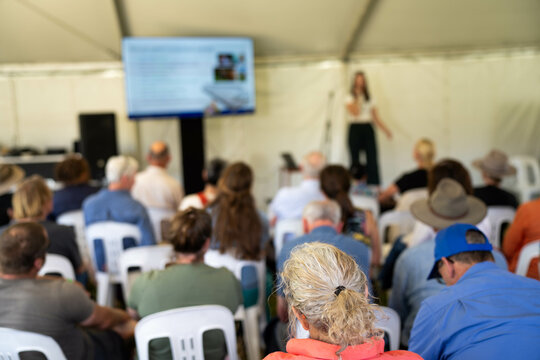
Through the William J. and Dorothy K. O’Neill Foundation’s partnerships with rural grantees, including the Foundation has learned that many rural areas, while rich in amenities, also face shared challenges such as limited access to services, scarce resources, and transportation barriers.
Rural grantmaking often operates in areas with smaller organizations that face these barriers, requiring flexible, long-term support and strong relationships. By contrast, urban grantmaking typically targets specific programs within larger, better-resourced institutions. The Foundation has also found that listening directly to communities is essential, which is why investing in rural hubs works because these trusted local organizations know their communities well. They can make the most of local resources and help build stronger services in areas with small populations, limited infrastructure, and a smaller tax base. Check out a snapshot of the work of our Rural Hub Partners below.
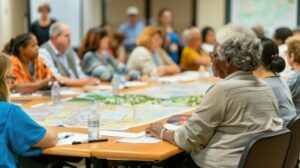
For more than 30 years, Lake Placid and the greater Adirondack region have held a special place for the O’Neill family. In 2024, the Adirondack Community Foundation convened O’Neill family members and three school districts—Saranac Lake, Lake Placid, and Brushton-Moira—to showcase their Community Schools model, which provides services such as health care, after-school enrichment, and family supports.
As the philanthropic hub of the Adirondack region, the Adirondack Community Foundation occupies a distinctive position as both a funder and an active nonprofit organization. Through ongoing relationships with local government leaders, nonprofit organizations, and other community stakeholders, the Adirondack Community Foundation gains continual insight into the challenges and priorities facing the region.
The Adirondack Community Foundation uses its knowledge of the community to connect local organizations and residents with funders, directing support to projects that can make the biggest difference. By building strong partnerships across the region, the Adirondack Community Foundation stays closely connected to local needs and helps improve quality of life throughout the Adirondacks.
In fact, this is all part of their Strong Community Framework for the Adirondacks, which guides their work to create strong and more equitable community for today and the future.
Vibrant Hawaiʻi is a community-driven nonprofit that serves Hawaiʻi Island’s residents primarily from under-resourced, rural, and remote communities and empowers them with tools to strengthen resilience, and local leadership across systems and daily life. In fact, both Vibrant Hawai’i and the Adirondack Community Foundation were recognized by the Trust for Civic Life, a national grantmaking collaborative, as 2024 Civic Hub grantees. The designation recognizes local organizations that bring communities together across differences and foster innovative approaches to civic life.
The organization was founded in 2019 on Hawaiʻi Island in response to ongoing challenges like poverty and unequal access to resources. Created by local leaders and supported by partners such as the Hawai‘i Community Foundation, it focuses on the strengths already present in island communities, like strong family (‘ohana) ties, cultural traditions, and natural resources, while giving residents a voice in shaping solutions.
At its core, Vibrant Hawaiʻi helps bring people together to solve problems in fair and culturally meaningful ways. It works across many areas, including education and jobs, health and well-being, housing and economic opportunity, cultural preservation, community engagement, and disaster preparedness.
One of Vibrant Hawaiʻi’s signature initiatives is the network of Resilience Hubs spanning the island. These hubs are place-based, community-led gathering spaces where residents build connections, access essential resources (like internet, training, and emergency planning), and coordinate local responses before, during, and after emergencies. Each hub is led by people who live in the community, and it serves but connected through an islandwide network for shared learning and mutual support.
When the William J. and Dorothy K. O’Neill Foundation first explored funding in southern Vermont, we quickly connected with the Stratton Community Foundation, which bridges donors, volunteers, community partners, and residents in mountain towns where poverty is largely rural and above the state average. The Foundation’s grants helped launch a middle school student success program, supported emergency response during COVID, and funded general operations, advancing the Stratton Community Foundation’s mission to remove barriers that prevent children from being healthy, safe and ready to learn.
Founded in 1996, the Stratton Community Foundation set out to bring people together at Stratton Mountain, provide education grants, and support local programs in the communities where Stratton employees lived and worked. In 2010, it formalized a partnership with Stratton Mountain Resort, connecting visitors who love Vermont with the local families who call it home. Together, they work to address childhood poverty and support the overall well-being of families across the region.
Today, the Stratton Community Foundation supports 20 towns within a roughly 40-mile radius of Stratton Mountain. Its service area includes approximately 8,100 families of two or more members, representing more than 3,500 children. Depending on the town, between 30% and 90% of children live at or below the poverty level, as defined by state guidelines. For context, a family of four earning less than $36,000 annually qualifies under this measure.
The Stratton Community Foundation continues to work in close partnership with Stratton Mountain Resort, whose leadership and ongoing support play an integral role in advancing the Foundation’s mission and community impact.
Through this role, the Stratton Community Foundation advances a shared mission to support local youth and strengthen the surrounding communities by cultivating strong partnerships, expanding its reach, and delivering thoughtful, solution-driven programs that create lasting impact.
Overall, rural civic hubs function as the connective tissue of a region. Like a campus that coordinates many moving parts, they align partners, braid resources, and strengthen local leadership so communities can tackle challenges together. While services may flow through them, their deeper role is to build trust, surface community voice, and link funders with on-the-ground priorities. By serving as conveners, capacity builders, and system stewards, rural civic hubs help small towns move from isolated efforts to shared strategy—advancing community-driven progress.

The Rural Communities Team believes that addressing the unique needs of rural communities in a hyperlocal fashion will provide outsized results to this under-resourced area of philanthropy. Our grantmaking supports communities in Hawaii, Vermont, Charles City County (VA), and the Adirondack region (NY) by investing in the highly motived and creative people and organizations who persevere despite the inherent infrastructure challenges that accompany their work. Grants are directed to strength-based approaches that build on the resilience of rural communities.